Powered by Blogger.

Lost in Translation


Israel is a special, sacred place for billions of people around the world. Christians, Muslims and Jews all come to the place for its religious significance. And I? I mainly went to trace my family's footsteps, made in 1997 when my grandparents took everyone to the Holy Land. My trip was an amazing experience with some sharp edges. I think the best way to explain why is by showing you the spontaneous thoughts I had in Israel.

Isreal... I'm flying over the Holy Land!

Getting through customs is scary and difficult here.

Thank God there's street art in this place.

These Israeli beds are ridiculously small.

How can people like hummus? This stuff is awful!

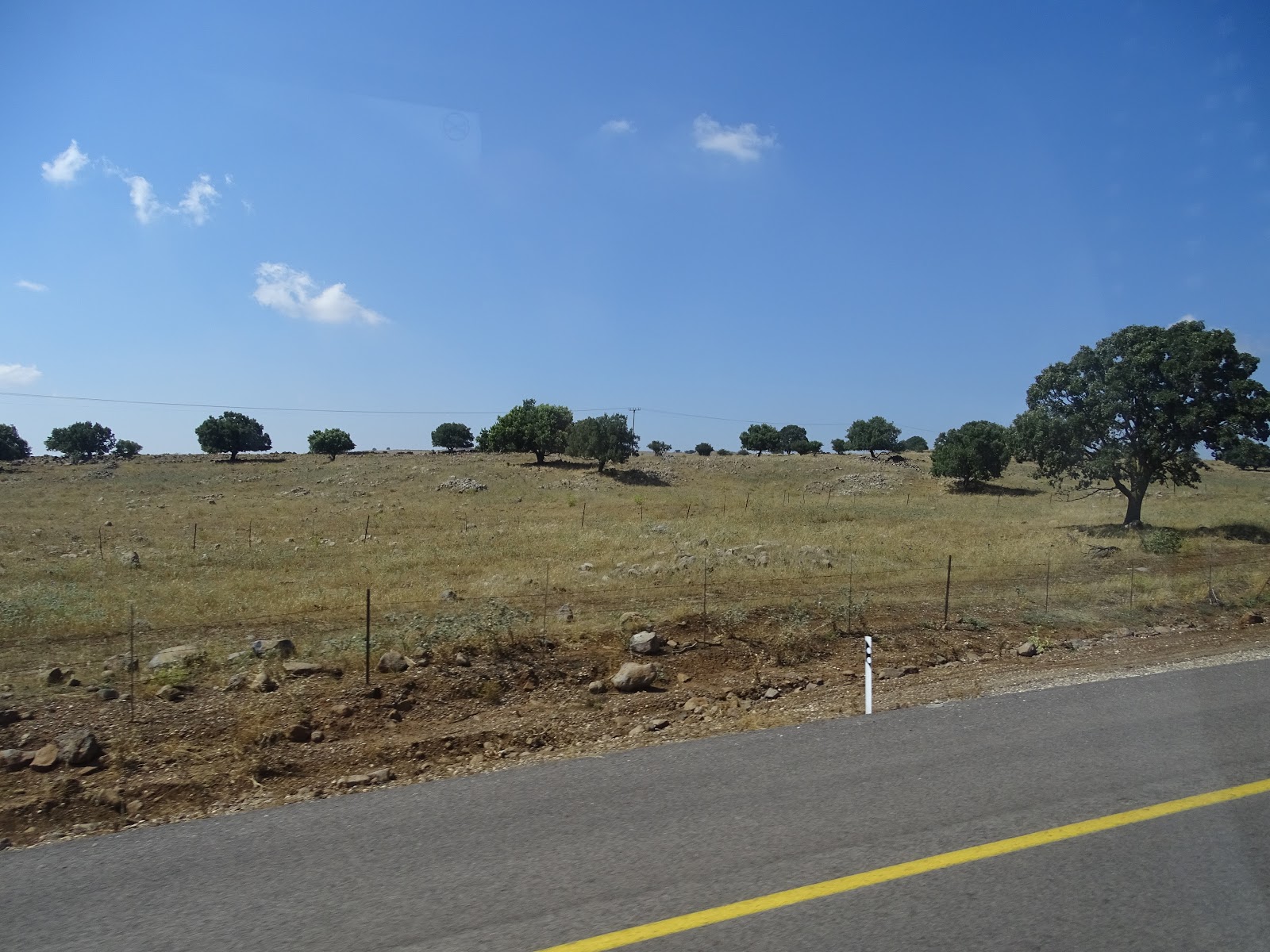
I think I'll refrain from going to the beach if that includes walking through a barren wasteland.

I like Caesarea. It reminds me of Latin class.


Why are there so many Pizza Huts in Haifa?

I wish I had more time to check the Bahai Temple and Gardens out.

Megiddo is nice, but not all that impressive. Unless you believe the apocalypse will start right freaking now.

It is too freaking hot in this desert country.

*Old Dutch Christmas song about Nazareth*

Finally I'm out on my own! No group of tourists around me! This feels so much better!

I was made for this. I was made to explore this world on my own.

I had one local beer and I'm already feeling a bit... drunk...

Walking back to the hotel all by myself at 8pm in total darkness is pretty freaking scary.

Please keep that evil dachshund away from me!

It's too early to be on a boat on the Sea of Galilee...

Apparently Jesus was on this hill once. That's quite interesting.

These gardens are much greener than I expected any place in Israel to be.


Apparently Jesus was on this hilltop too.

Apparently Jesus lived here.

Is it just me, or was Jesus on every hill here?

Fish from the Sea of Galilee tastes too... fishy.

I am both excited and terrified to visit Golan.

I can't believe this is Syrian territory occupied by Israel, I can't believe the Syrian war is raging behind that fence over there, I can't believe all these tourists are gawking like they're at the zoo...


No better place to relax after such a busy day than swimming in a pool. I needed this.

Am I in Jerusalem already, or is this the West Bank?

Nice and morbid view of the city with this cemetery on the Mount of  Olives right in front of us.

I'm sorry, but why aren't we talking about the Al Aqsa mosque? Or anything Islamic for that matter?


These streets are so slippery that I'm pretty sure I'd be able to slide all the way down the Mount of Olives on my bare feet if it weren't for all the cars.

So Jesus was in this garden, and on that street, and on that hill. D'you think he was on that hill too?
"Douwe! D'you reckon Jesus was on that hill?"

I love how security says the X-ray machine at the Western Wall is in 'Sabbath mode', which literally means it's turned off.

Whoa, calm down, angry French lady! I won't take close-ups of the Western Wall, no need to yell.

Apparently I have to walk away from the Western Wall backward. Let's just hope I don't walk into anyone.

Why are we constantly rushing from one place to the next? I just want to explore on my own!

God, just seeing the West Bank Barrier makes me sick to my stomach.

Banksy's white dove! He was here!

I could have done without a visit to Yad Vashem with a yelling tour guide... I feel awful now.

Never thought I'd be this glad to return to the West Bank.


I don't think you can see the bigger picture of the Israeli-Palestinian conflict without visiting the West Bank Barrier. This is... It's left me speechless.

Why did the tour guide say that Bethlehem is boring? There are cute rooftop terraces, a beautiful city center and a KFC with the best view for a fast-food restaurant ever.

Should I make a post with Palestinian thoughts? I feel like I can't, because we're constantly leaving the West Bank.

Seriously? I'm not allowed to walk up to the Citadel of Massada because there isn't enough time? So instead I have to wait for half an hour on the funicular?

I wonder how much has changed here since our family visit in 1997.

I hate Israel's attitude when it comes to certain things, but I can't deny that the country is beautiful.

Seriously?! We just get enough time to walk up to the first waterfall at Ein Gedi?! No more?!


I'm not going back yet. I want to take pictures.

SERIOUSLY?! We get less than an hour to swim in the Dead Sea?!

This beach looks like it suffered an oil spill...

The water feels slimy, but I've not felt this calm and relaxed since arriving in this country.

I'm not gonna lie: I'm glad I'm crossing the border into Jordan today.

As you might have noticed from my thoughts, I wasn't always happy with the way things were going in Israel. The country's policies on some issues felt unjust to me. Add zionist and evangelical propaganda to that, spewed by a tour guide who gave us very little time to enjoy Israel's natural beauty and you can see why I often felt irritated and frustrated. As a result, I can confidently say that I won't visit Israel again unless A, they make some big changes in their attitude towards Palestine, or B, I somehow get involved in a humanitarian cause on the West Bank. Otherwise, Israel will end up on the list of countries I don't care enough for to visit again within 20 years or so. I'm not saying you shouldn't go there though. I'm just saying you won't see me in the Holy Land any time soon.

x Envy
Twitter | Instagram | Facebook
Share
Tweet
Pin
Share
4 Fellow Ramblers

Nappy rash is possibly the worst thing I experienced as a baby. Not that I have any conscious memories of it, but there's an experience I had as a baby in Israel's Dead Sea that planted itself so firmly in my brain that I still instinctively shy away from salt water. There's this hint of a memory of a burning sensation, connected to being immersed in water. My mom told me I'd screamed and cried when I went 'swimming' in the Dead Sea at the age of one, while suffering from nappy rash. Twenty years later, I wanted a do-over. No screaming, no crying, just peaceful floating in the Dead Sea. I got my do-over in June, but... it was nothing like I'd imagined.

My big day started with a quick visit to the citadel of Masada. I wanted to climb the path to the citadel like my dad and cousin had done 20 years earlier, but my tour guide vetoed this plan. Because of this and the way he'd acted in Jerusalem, I was starting to suspect that he wasn't a big fan of adventures that had nothing to do with the Bible. My suspicions were confirmed when we spent ages talking about biblical events that took place at Ein Gedi (all I remember is that some king's father-in-law took a dump in a cave, sorry) and only got 20 minutes to take pictures and swim near the waterfall. Since the Dead Sea has no ties to any big biblical events as far as I know, me and the friends I'd made on this trip feared we'd get only a few minutes to enjoy this iconic place. Sadly, we turned out to be right.

After a short, very short visit to the place where the Dead Sea Scrolls were found, we finally took the bus down to the banks of the Dead Sea. It was late in the afternoon already and with every cute and Instagrammable beach we passed, I got a little more frustrated. It wasn't like we had all the much time left in our day and I wanted to jump into that stingy salty water sooner rather than later.
Finally, the bus stopped at Kalia Beach, the very last beach on the western bank of the Dead Sea. It didn't look quite as cute and Instagrammable as most of the beaches we'd passed, but I didn't want to judge right away. The most important thing for me at that moment was getting my bikini on asap. Changing turned into quite the struggle though: first I had to walk past and through a few souvenir shops full of products with Dead Sea salt to get to a changing room. The changing room itself was a nightmare for a prudish, insecure and skinny girl like me. In one gigantic room without any cubicles, surrounded by loads of women, most of them middle-aged or older, in various states of undress, I struggled to get my bikini on while keeping as much of myself covered as possible.
My bikini wasn't cooperating at all. The temperature in the changing room was well above 30 degrees Celsius and the humidity high enough to support marine life. Every piece of fabric that came close to my skin got stuck like I was some kind of sweaty magnet. A few minutes that felt like a few hours later, I sprinted out of the changing room. As expected, we'd only gotten 60 minutes to spend on this beach and I'd wasted an awfully big amount of that time on getting changed.

My friends were already waiting for me on the beach and we quickly walked in the opposite direction of the rest of our tour group. We passed the Lowest Bar in the World, then finally saw the entire beach. It looked nothing like the Dead Sea beach I knew from the pictures of our 1997 family vacation. Kalia Beach was filled with cheap plastic lawn chairs and parasols that'd seen better days. It was also pretty crowded, so we made our way to the far end of the beach, where there were still some empty chairs left. We slipped and slid all the way, not getting much grip on the brown mud. There was a weird, slimy sheen over everything, making me feel like I was on a beach shortly after an oil tanker had crashed into it. I felt dirty. Disgusting.
'Now I know how birds feel in oil spills,' I said out loud, sticking to that allegory.
'It's certainly not the prettiest beach a tour guide could have taken us to.' Truer words were not spoken that day. 200 meters to our left, a chainlink fence marked the border with Jordan. All around us, everything was covered in a thin layer of brown, slimy water and salt. To the right, I could see a prettier, cleaner beach behind a small patch of reeds and other plants. I wasn't too happy with the whole situation, but decided to try and enjoy the whole experience anyway.


After I dumped my stuff on one of the many slimy lawn chairs, I kicked off my flipflops and tried to make a run for the water. Within five seconds I ran back, crying for my flipflops (and secretly, in my mind, I was crying for my mom). The muddy shore burnt my feet, making me feel like I was walking through fire. I took my flipflops with me as far as I could, though everything in this environment becomes slippery within seconds and as a result, I spent quite a few moments with my heels, toes or the sides of my feet touching the scorching mud.

Leaving my beloved Havaianas on the bank was difficult. Half of the planet seems to have the same black pair I have, and since I saw quite a few get picked up by other tourists by mistake in my time in Thailand, I hoped I'd see them back by the end of the day. My mind was filled with small worries like this one. It was quite stressful. How much time did I have left? What if I'd slip and fall? What if I'd accidentally swallow a mouthful of Dead Sea water? That could kill me, my buzzkill of a tour guide had said multiple times.
Carefully, I stepped into the water, trying to remain steady on my feet. On top of my conscious worries, the instinct born out of burning nappy rash making my previous visit to the Dead Sea a living hell. Of course, the moment I realized that, I slipped and fell...

I'M GOING TO DIE.
I'll swallow water and die.
That's all I could think as my legs gave way and my upper body splashed into the Dead Sea. I took a deep breath, braced myself for the moment my head would break through the surface. It didn't happen. My hands found solid ground, as did my knees. I let out an almost hysterical laugh, then waded further into the water. It didn't burn at all, though there was a slightly unpleasant tingle, which made rubbing mud and water all over me like some tourists do sound very unappealing.
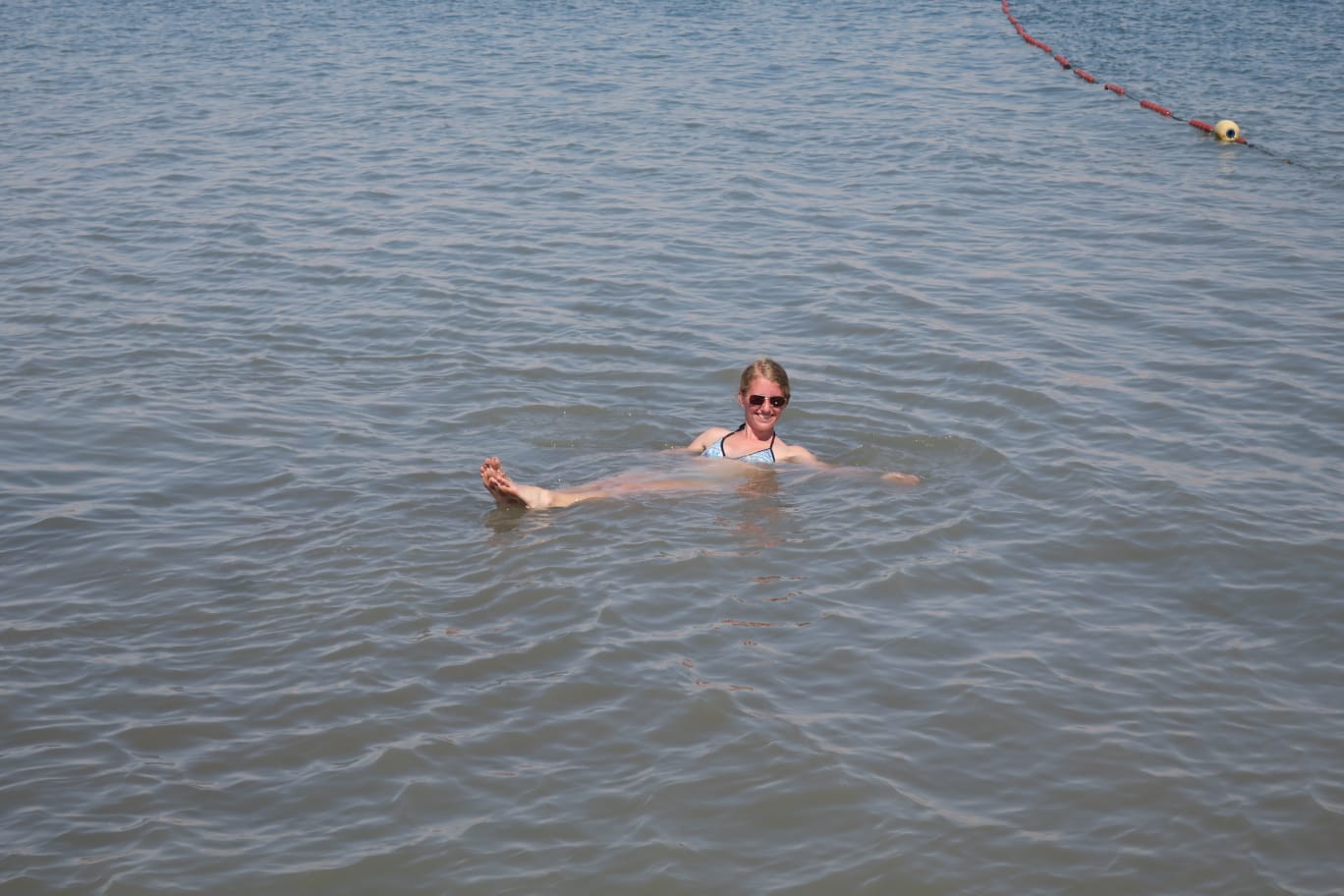
When the water was up to my thighs, I leaned back and let myself float away. It actually worked, even though I usually sink within seconds of entering any body of water. I was tense though, afraid of swallowing water, annoyed by the shabbiness of Kalia Beach, rushed because of the lack of time we had at this unique place. I paddled around for a while, unable to fully enjoy it. I smiled for the camera as my friends took pictures, but wished I was on one of the fancier beaches.
Then, for no particular reason, I decided to let it all go. I leaned back further, until the salty water filled my ears. The noise of dozens of tourists disappeared. I looked up at the cloudless sky and saw the moon. I smiled. For the first time in months, maybe even years, I was at peace.


Despite the beauty of that moment, I wasn't fully able to shake my disappointment off when I left the water. But my Havaianas were still where I left them, so that was a plus. I sat down on one of the lawn chairs and slipped off right away. There was a slimy sheen on my skin. I'd gone from oil spill bird to slippery slug. I took a sip from the can of lukewarm coke I'd gotten at the KFC in Bethlehem the day before. Before I could finish it, or even take any good pictures for this blog post, I had to rush back to the bus. I was happy that I didn't end up crying like I did on my 1997 visit, but also a little frustrated that I hadn't gotten the time to relax and enjoy the Dead Sea on my own terms (read: take decent pictures and write on the beach). And so my visit became a paradox: a disappointment, but a satisfying one.

x Envy
Twitter | Instagram | Facebook
Share
Tweet
Pin
Share
6 Fellow Ramblers

One of the main to go for group travel to join on my trip to Israel was that everything would be planned out and confirmed already. You get some time to explore by yourself here and there, but visits to museums and transportation to the next city are all taken care of. So every morning in the Middle East, I'd look at the travel program I'd gotten and know what's up - until we hit Jerusalem. As it turns out, the travel organization had given out two different programs, with some significant differences between them. One stated we'd get half a day to ourselves to explore Jerusalem, the other said this would happen in Bethlehem. A quick vote decided we'd spend that afternoon in Bethlehem. I quietly cheered: this meant that I could go look at the street art on the West Bank Barrier!


The West Bank Barrier, under construction since 2000 by Israel, is a hideous concrete structure that spans 708 kilometers, separating the Palestinian West Bank from Israel. It's also known as the Separation Wall, Security Fence or Wall of Apartheid. The wall legendary in the street art world, partially because of how much space it offers, mainly because Banksy left some clear political statements on it. After seeing his work framed at exhibitions in Antwerp and Amsterdam I was dying to see Banksy's art in the wild. My tour guide, a very anti-Palestine man, completely lost his temper when he heard me say I was excited to go to the Barrier for the art.
'Do you even know why that wall was built?!' he basically yelled at me. I admitted that I didn't. As it turns out, the Israelis say that they built a concrete barrier to protect themselves from Muslim suicide bombers. The Palestinians, however, see it as racial segregation. They're vocal about it, and one way to show how they feel about the situation is through art on the very thing that symbolizes the problems in the region. It's this combination of art and politics that drew me to the West Bank Barrier while the rest of the tour group went to visit churches and biblical places as usual.


After a very brief, more or less obligatory visit to the Church of the Nativity with the entire group, I set out for the wall with the friends I'd made in the group, a young Frisian couple. We walked through the old city and soon saw the first signs of Banksy's visit in the shape of some relatively small stencils depicting children playing with bombs and toys made of barbed wire. One of these stencils happened to be on the corner of the street our hotel was on. It was a nice warm-up for what was to come, though we decided to take a little detour to one of Banksy's works on the wall of the Palestinian Heritage Center on Manger Street. Here, a huge white dove in a bulletproof vest offers an olive branch while trapped in a sniper's crosshairs. My Frisian friends hadn't seen it yet, so I showed them the mural and explained how it was made. In terms of artistry and message, it was one of my favorite pieces of the day.

Once we'd taken enough pictures to last us a lifetime, we left for the wall for real now. We approached it from Manger Street, then Hebron Road, where we were greeted by concrete blocks with slogans in crude spray painted letters on them. For a second I was scared. Up until that moment, I hadn't really thought about safety much, as Bethlehem was so calm and the people so friendly. But the concrete blocks and enormous watch towers sent shivers down my spine. What if walking too close to the barrier would be viewed as a threat by the Israeli army? At the same time, my mind registered the details and size of the enormous murals and I realized those were a sign of safety: if anyone approaching the wall would be seen as a threat, there would be no art there.


We walked straight up to the barrier, down an alley were not many tourists seemed to come. I was in street art heaven. I snapped picture after picture and eventually even climbed up on the base to slap one of my own stickers on the West Bank Barrier. It was so different from all the biblical places I'd visited with the group. It was beautiful in a painful way. It made me want to change the world in ways I can't, because I simply don't have that kind of political power. All I can do is talk and write about Palestine, just like most Palestinians can only paint on this awful wall to let their voices be heard.


"Make hummus, not walls" seems to be the slogan of the Palestinians, though they also don't shy away from calling the West Bank an 'outdoor prison' on the endless concrete. There are official plaques with information, but you'll learn far more about the situation in Palestine and the way Palestinians experience it by looking at the graffiti. The 'ugly' tags are voices shouting the opinions of those who experienced oppression, the beautiful murals are well-written pleas for peace and justice. There was a huge piece depicting Messi shooting a football through barbed wire, as Argentine canceling a match with Israel prior to the World Cup was seen as a positive thing on this side of the wall. There's a mirror, showing us we're all people, no matter our background, culture and religion.


The paint fills every inch of the concrete here with countless Palestinian flags, the words "Free Palestine" and the ever-present "Make hummus, not walls". Of course there are original Banksy pieces too, but though they were what drew me to the wall in the first place, the piece that hit me hardest was a huge portrait of Razan, a Palestinian girl who volunteered as a nurse/paramedic but won't ever treat another patient again: She was shot by the Israeli army while she was treating a patient close to the border in Gaza last June. The Dutch media has remained eerily silent on this story...


Though the situation is grave, the colorful murals lifted my spirits while I walked along the West Bank Barrier. Yet the art wasn't the only interesting thing on this walk. Soon Palestinians came up to us to tell us about life on the West Bank. The man attending to the small shop full of Banksy merchandise went out of his way to explain the Messi and Razan paintings. He pointed details out and handed us a ladder so we could take better pictures. Another man came up to us and, in an attempt to get us to buy a drink from his stall out of pity, told us he had fairly recently gotten out of prison. He'd killed a man: after his innocent father had died in a tear gas attack from the Israeli army, he went berserk and left the Israelis with one soldier less in their ranks. Though I can't vouch for this particular story, it was still shocking to hear, because this is the harsh reality for Palestinians on the West Bank as well as in Gaza. It's an insight like this, meeting locals and talking to them, that made the whole experience even more special.


After our conversations with the locals, we continued walking along the wall until we reached Banksy's Walled Off Hotel. I didn't go inside, because the wall intrigued me more. Sadly, the street art was quite low-quality here. Right next to the Walled Off Hotel, shops have popped up where you can hire spray cans and stencils. This has resulted into layer upon layer of rip-off miniature Banksies and generic images like superhero logos and even Taylor Swift's album cover for Reputation. The latter appalled me. To me, the West Bank Barrier shows we didn't learn from Berlin: It's a place to think about the way we as humans treat one another, not a place to stan your favorite artist. I also wonder how Banksy, who is known for his anti-capitalistic views, feels about his stencils being rented out as a fun activity for tourists, helping them leave their mark on this wall with no thought behind it whatsoever.


At that moment, just as I was getting fed-up with the commercialization of art and political statements on the West Bank Barrier, we decided to turn back and go for a drink in the old city. We could have walked on for much longer, all the way up to Checkpoint 300, but I think that would have become overwhelming. There's so much to see that you don't really take it in anymore after the first couple of hundred meters. I could've spent days looking at all the art, but we had a trip to the Dead Sea planned the next day. I fully enjoyed my time at the wall though, weird as that may sound considering the political situation it symbolizes. The thing is, this afternoon in the shadows of the West Bank Barrier gave me a better insight into politics and life on the West Bank. Without this visit, I only would've seen the Israeli side of this conflict's story. If you're looking for the Palestinian side, this is the place to go: you'll see it told in the beautiful and raw language of street art.

x Envy
Twitter | Instagram | Facebook
Share
Tweet
Pin
Share
2 Fellow Ramblers

I never planned on writing this post. I'd be too political, too much religion thrown into it, too many controversial opinions shared. Israel is a conversation anyway and I never wanted to make anyone feel Lost in Translation doesn't welcome them for having certain opinions. It's the internet, so I rather stayed away from complicated matters. But looking back on my time in Israel, I realized I absolutely had to write about Jerusalem and the way our visit was organized there. This will be no fun storytime, no post full of recommendations, but my honest opinion on the way a Jewish tour guide steered us away from opinions that weren't the same as his.

I'd like to tell you that my arrival in Jerusalem made quite the impression on me, but I can't. In fact, I don't even remember first entering the city. I was dozing off in the bus, only half-awake at best. My first view of the city was the famous on from postcards and travel brochures: we got off the bus at the viewpoint on the Mount of Olives. The city looked beautiful in all its vastness, but the first detail I noticed in this massive urban sprawl was a huge golden dome.
I expected our tour guide to tell us all about the impressive sight in front of us, but being most interested in the golden dome, I first took some pictures of it while he told about all the other building we saw. Then I took some pictures of other people. Then they took some pictures of me. And when all that was done, I still hadn't heard anything about the golden dome. Later that day, in my hotel room, I learned that I'd been looking at the Al Aqsa Mosque, the third holiest place in Islam. A mosque our Jewish tour guide told us very little about. Even if he did tell us, his story was so short that I completely missed it while taking pictures, at most 10 meters away from the group...


When all the pictures were taken, we walked down the Mount of Olives, slipping and sliding on a sloped street. I was wondering when we'd hear something about the role of Islam in the history of Jerusalem. I'd always heard how important Israel was to three major religions. Now that I was finally there, I saw only two represented: we visited a Jewish cemetery, two churches, the garden of Gethsemane... and not a single place where Islam was the most important religion. Sure, our tour guide mentioned when and where Muslims had lived in Jerusalem, but I felt like we focused a bit too much on Judaism and Christianity.


Don't get me wrong though. I enjoyed my brief visit to all the major sights. The garden of Gethsemane was beautiful and I'd bombard you with pictures if they weren't full of Italian tourists. The church in the garden, where Jesus apparently sweated blood, had a pretty cool facade, the Lion's Gate made me feel like a 16-year-old Latin student again and hearing about the Biblical significance of all these places was very interesting. I don't want to build my life on what that book tells me, but it's awesome to walk down the Via Dolorosa understanding why it's such an important street to so many people around the world (in case you're not Christian: Jesus dragged his cross down that street).


We walked through endless streets and a souk. Then, when I was daydreaming for a bit, we found ourselves at a gate to the Western Wall, where we had to open our bags and show everything inside to the security guards. This is usually done by X-ray, but the X-ray machine was on 'Sabbath mode', fancy for 'it is turned off because it's Saturday.' After a very aggressive French lady told me not to take any pictures, I walked up to the Western Wall and prayed. I'm more of a messed-up Buddhist than a Jew, but I believe every sacred place is a good place to pray (told you this post would have more serious opinions than my average ramblings).


After lunch, I once again found myself wondering about the Muslims who'd left their mark on Jerusalem. I saw countless pretty streets and had a lot of fun, but my curiosity kept nagging. At the end of the day, I felt like everything Islamic was being neglected and ignored by the people who'd organized this trip.

That night at Jaffa Gate, I heard my tour guide rant and complain about Muslims. It shouldn't have surprised me after his radical stance on the situation on the Golan Heights. It did explain why he didn't tell us much about Islam in Israel.
When we got on the bus to Bethlehem, where our Jewish tour guide wasn't allowed to stay the night, he told us as little about Palestine as possible. The way he described it, Bethlehem was the most boring place in the world. The West Bank Barrier, separating Palestine from Israel like a Berlin Wall on steroids, was barely acknowledged.


The more time passed, the angrier this situation made me. In my humble opinion, you can't ignore an entire religion in a place like Jerusalem, but we did. You can't just go to the Jewish and Christian landmarks, but we did. You can't remain silent on the problems in Palestine, but we did. You can't refuse to look at all the sides of the story, but we did. I didn't want to gloss over the situation in Palestine, but with a tour guide who kept us away from things he didn't agree with, it wasn't easy to learn more about the other side of Jerusalem and the West Bank Barrier.


That night, our bus driver took us on a tour of Jerusalem. Suliman, a practicing Muslim, showed us the side of the city I'd been longing for. We saw the Arab quarter and the Damascus Gate. We were told about mosques and other important places. Sadly, no everyone in our group decided to tag along. I feel like those who didn't come, never saw the full picture of Jerusalem. The same happened the next day, when I visited the Palestinian side of the West Bank Barrier with two others. My parents always taught me to stay true to my own opinion, an opinion based on stories from both sides. It was simply impossible to do so by staying with the tour guide and group all the time.

Where am I going with all this? To the point where I ask you to do the same thing I did if you ever go to Israel: don't allow a tour guide to spoonfeed you propaganda. Go and see all parts of Jerusalem. Talk to a Jew, a Christian and a Muslim. Go see the West Bank Barrier. But don't be that person who refuses to see that Islam has made Jerusalem to what it is too.

x Envy
Twitter | Instagram | Facebook
Share
Tweet
Pin
Share
9 Fellow Ramblers

The Dutch Ministry of Foreign Affairs has nice little maps of every country in the world on its website. They're color-coded to show you how dangerous it is to travel to a country. I never looked at the map of Israel before I went there. Had I done so, I would have seen a bright red strip of land near the Syrian border. "Don't go to Golan Heights,' our caring ministry tells us. Now can you guess where I went when I was in Israel in June? Yup, that's right. I went to the Golan Heights.

I was pretty nervous when we drove towards the Syrian border. I'd never heard of Golan before, but our tour guide filled us in. The Golan Heights is a Syrian region, occupied by Israel. It's been that way for decades now and recently Iran felt the need to make some threats to get Israel to give up the place. Heavy ammunition is in place at all times. According to our tour guide, it's safe because of the dispute: no one would dare to fire first, out of fear of escalating the conflict. So Golan is a safe and fun place, where you can hear the bombs explode when the war gods play their games in Syria. Great, awesome, why were we going there again?


Half of me was quite scared, but the other half of me saw this as an adventure. World's most well-known warzone was just around the corner! My excitement disappeared the second I spotted an army helicopter. Around the same time, we passed an army base that looked abandoned.
'They're all out in the field, on patrol,' our tour guide, a former army guy himself, told us. I did not see that as a good sign. There were no tanks and army vehicles in sight, but knowing they were out and about was unsettling.

Our bus stopped near the summit of Mt. Bental, a dormant volcano close to the current Israeli-Syrian border. It was a quiet day on the other side of the high fences separating one country from the other, with no bombs falling from the sky and no smoke billowing over the Syrian plains. That calmed me down, though I did get very confused when I reached the actual summit by foot. In my mind, we were visiting a calm mountain in the middle of nowhere. In reality, Mt. Bental was a full-fledged tourist trap with a coffee house, fancy sculptures and a souvenir shop. Not exactly what I'd expected. It felt a bit surreal, even more so when I took a step back and watched my tour group stare at the yellow war-torn fields of Syria the same way you'd look at a mentally challenged monkey at the zoom; it feels wrong to stare, but you can't look away because it's strangely interesting.
'Weird how we use war and someone else's misery as a tourist attraction,' I remarked.
'But don't you think war is big business?' one of the older men from the group asked me.
I considered that for a moment. I tried to think of all the weaponry, ammunition, vehicles and people involved in this one war, then added the tourism money from Mt. Bental to that. Our bus had been of a dozen buses to visit Golan at that moment. It was insane. I had to agree with the man.
'Not just any big business, the biggest business,' he said. In the meantime, the next group of tourists had arrived to have a look at Syria's misery.


After that short conversation, I felt a little uncomfortable exploring the rest of Mt. Bental's summit. If you were able to forget about its location and the bright red color of the area on the Ministry's map, you could have some real fun there. Mt. Bental was a stronghold in the Yom Kippur War and its bunkers are still intact. You can explore them on your own if you have a flashlight and the guts to walk into a dark tunnel on the edge of an actual war zone. It's also cool to see the UN officers on duty there at work, but it's also a grim reminder of the whole situation. These guys were okay with me taking pictures of them, I guess because it offered them a little distraction from endlessly staring at a similar place on the Syrian side of the border and the rare care that drove past a quarry.


Well within the hour, I'd seen pretty much everything there was to see. Even though the trip to the Golan Heights had seemed safe enough all that time, I felt a wave of relief wash over me as we left the area. I'd like to recommend the place to you, but I won't. I visited Mt. Bental on June 15th, when it was relatively calm in the wider region. Our guide happened to live in Golan, so he knew what he was doing. If he hadn't been there, I never even would have thought about getting so close to the Syrian border. And if I'd get the chance to visit today, I'd turn the offer down. Back in June, only Iran was ready to shake things up. Over the past weekend, however, both Israel and Syria have been preparing to do damage, with missiles reportedly landing in Syria already.
Apart from the safety risks, people visiting Mt. Bental seem to forget they're visiting land that Israel violently took from Syria, visiting that place to look at the pain and misery of innocent civilians living in the hell of war. So I'm going to end this post by saying something I usually never say in my travel posts: Please, don't go to Golan.

x Envy
Twitter | Instagram | Facebook
Share
Tweet
Pin
Share
2 Fellow Ramblers

See what I did there, with the title? The Toy Story reference? Okay, I'll stop with the bad jokes now, but I found it very fitting: in June I visited Israel, Palestine and Jordan. It was the first time I left the continent without my parents, the biggest adventure of my life so far... Needless to say, I was scared to death when I left.

I landed in Tel Aviv, Israel, just a few minutes before midnight on June 13th. Even though it wasn't my first time in Israel, I felt pretty lost. I had no memories to rely on: my previous visit was in 1997, when I was exactly one year old. All I know about that trip is that I cried in the Dead Sea and that my cousin ate four popsicles a day.
 Lucky for me, I wasn't all alone in the Holy Land: I'd booked a tour with a group (to my fellow Dutchies: never book a Kras trip via TUI!). I turned out to be the youngest one there, the average age of the group being somewhere around 60, probably above it. Not that age mattered all that much in this group; I got along pretty well with the oldies and mostly hung out with a young couple from the north of the Netherlands.


After a very short night in Netanya, we paid the quickest visit ever to the Roman city of Caesarea, Haifa and Nazareth. I felt like one of those Asian tourists who travel through all of Europe in two to three weeks. Quick picture stop here, bathroom break there and on to the next tourist trap. The tour guide was not a big fan of photography, as he only gave us as little time as possible at monuments and viewpoints. Luckily our bus driver understood the need for good snaps, which led to actions like driving three full circles on a roundabout at the foot of the hill that's home to the Bahai Shrine in Haifa.

The pace of our trip didn't slow down after that first jampacked day. Soon I'd visited Tiberias, the Golan Heights, and many, many, many places where Jesus had been. Also a lot of places where people committed mass suicide. The Bible says so. Very uplifting...
On the third full day in Israel, I already distanced myself from the group every time the tour guide pulled the Bible out of his pocket. Unlike many others in the group, I hadn't come to Israel for its religious significance. Sure, it was interesting to hear about things that had happened there according to religion, but I was more interested in tracing the footsteps of my family from that 1997 trip. I was there for the desert, for the three major religions coming together in Jerusalem, for the art on the West Bank Barrier.


The tour guide wasn't a big fan of my plan to visit the West Bank Barrier, but I didn't let that stop me. As soon as we had some time off in Bethlehem, I was checking out that wall. Even though Jerusalem was beautiful, I enjoyed this Palestinian city more. One of my former coworkers had lived there (in case she's reading this: Hi! I hope you and your family are doing okay!), which made my visit a bit more special. This is the place where I watched football with locals, ate at the KFC with the best view in the world and almost went deaf when the call to prayer started when I was right next to the mosque. Bethlehem will always have a special place in my heart.


After a visit to the Dead Sea, we crossed the border into Jordan, my first Muslim country ever. I was glad to be there, since I'd come to learn more about Christianity, Judaism and Islam, but the latter had been almost completely ignored in Israel. Jordan was a whole different story. My eyes grew wide at the sight of Amman's King Abdullah Mosque, but also when I saw street signs in Arabic and women in beautiful niqabs. My family and friends back home were a little worried that I'd get in trouble for being a blond girl on the streets of a Muslim country, but the only time I felt unsafe was when I walked to a supermarket in Madaba, a city with a Christian majority. Apart from that, I felt welcome in Jordan, way more welcome than I'd felt in Israel. I also liked the place better because we got a new tour guide once we crossed the border, and this guy gave us more time to ourselves. Thanks to him, I got the opportunity to explore Petra on my own terms. I saw it at night, by day and burnt to a crisp in that legendary ancient city. I wish I'd had even more time there, but we soon found ourselves in the desert of Wadi Rum and the Roman city Jerash. Before I knew it, I was on a plane home already...

Looking back on my trip now, almost two weeks after coming home, I smile (but just a little bit, because I had my wisdom teeth removed two days ago and my jaw is killing me). It was a scary trip, a real adventure. It was also expensive, but I decided to spend my money on experiences, not things. I'll never regret that decision. The pictures are amazing, the memories and stories even better. As always, I can't wait to share all of them with you.

x Envy
Twitter | Instagram | Facebook
Share
Tweet
Pin
Share
8 Fellow Ramblers
Older Posts

Created with by ThemeXpose | Distributed By Gooyaabi Templates